
Posted October 9, 2025
Behind the Scenes – Site-Specific Theatre
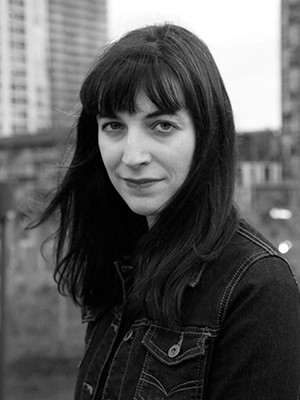
Rosamund Small
Rosamund Small is Artistic Associate at Outside the March Theatre. Her plays include Vitals, Sisters, Maven, and TomorrowLoveTM, an immersive theatrical experience about love, technology and the future. Vitals was honoured with Dora Mavor Moore awards for Outstanding Production and Outstanding New Play, as well as the Nora Epstein National Literary Award and the JP Bickell Award for Drama. Rosamund now writes for television shows including CBC’s Strays, Kim’s Convenience, and Tall Boyz. Rosamund studied Theatre and Sexual Diversity Studies at the University of Toronto. She is a graduate of the Soulpepper Academy.
Rosamund, let’s begin by talking about Vitals. For people who are not familiar with that play, tell us a bit about it.
Vitals is a solo show about a Toronto paramedic. When I was 19 or 20, I was babysitting for a woman who was a paramedic. And that wonderful person, Kelly O’Brien, mentored me and encouraged me and shared so much about what her job entails. Inspired by that and some other medics, some research, and my imagination, I created this story about Anna, who spends her days dealing with all different kinds of emergencies, from the mundane to the most terrible, and to the mundanely terrible. We follow her through these difficult events and the culmination of them becomes her own emergency—her work really takes a toll on her own mental health.
Vitals has had a wonderful production history and it brought me a lot of recognition early in my adult life. It still gets produced; about once or twice a year, someone out there is doing it. (Obviously, it was published by Scirocco Drama, and that’s such a special thing for me.)
Rosamund, can you tell us about where the initial production took place?
The show was premiered in 2014. It was produced by Outside the March and directed and produced by the lead of that company, Mitchell Cushman, who is still a very close collaborator of mine. He and his company were really excited about starting to do immersive and site-engaged work. I was also getting interested in that, partially through meeting them, partially through things I had seen from other cities. I was inspired by Mitchell’s work, and I had actually had the thought that maybe this play could live outside of a theatre space—more in the city, as it’s so much about all the parts of the city going on around you.
Mitchell had his own vision that was that, and more! So our audience met us with their tickets, and they got sent out, almost like they were on a call, to an address for a house in Roncesvalles. Inside the house was a metaphorical, beautiful scenic design…it was as though you were walking into this character’s memories, essentially, and her experiences. During the show the audience walked from space to space, following the actor as she told the story. Vitals is just one significantly long monologue that has very little physical action and no other characters, so it really lent itself to that kind of “just dive right into her head” format. It was such a creative production. I’m so proud of Vitals. There was a lot to love about the making of it and the sharing of it.
When other companies produce the play, do they stage it inside or outside the walls of the theatre?
I think it’s been about 50-50. None of them, I think, have been quite on the large scale of the original production, because there are such producing challenges with large-scale, immersive work. Some universities have done some site-specific interpretations, but it’s also been done in more traditional theatre spaces. But because Vitals is a really open text, in many ways it lets directors bring their own visions—it has no stage directions; it has no physical needs other than the performer. So I find it interesting what people bring to it, whether it’s really sparse, or really design-heavy, or whether they leave the theatre space or not.
You recently performed in your solo show, Performance Review, which was also a site-specific production. What can you tell us about that experience?
Performance Review is a big first for me. It’s my first show inspired by my real life. It’s just inspired by…but I’m Rosamund, my character is named “Rosamund,” and she’s had a really similar life to me! It’s my first time doing that, and it’s my first time being in one of my own shows, or really, performing at a professional level. So that was an interesting impulse. I didn’t want to pretend it was completely imagined, and I also wanted to name the character my own name, and I wanted to do it myself. So that was huge.
I also knew when I was creating this show that, essentially, I was creating stories of the workplace: different jobs and different professional workplace experiences, and I wanted the audience to feel really, really, really welcomed and held, and like they were close to me. That’s what I wanted for the show: I wanted to tell the story right to the audience and make them feel like their best friend was levelling with them.
So I took that impulse and looked at the show as a whole. The first story in the show is from when I’m 18 and I’m doing my very first job, which is as a barista at Second Cup—and I’m terrible at it. But I’m so excited. Like, this is my big break. I really needed a job, and this is it; I’m going to do it! Through my own process, I became interested in the idea that I would serve some coffee while I did the show. Mitchell got involved, and he became interested in taking that further by putting us into a café space. So the audience, they come in; they can interact with the space like you would a regular café. It’s not a set, it’s a café, and you can get a coffee and sit down and do all the things you do in a café. And then I come out, and I start clearing dishes and I start working at the cafe, and then I start telling stories. And even though I then I tell another story that isn’t set in a café…and we sort of leave, and leave, and leave…there’s a metaphor deep in it, of this person going back to her innocence and who she was when she was that age. When that was what her idea of what a big job was, this little cozy space. And that’s where we are. So it has a nice meaning, and it has nice audience interaction.
Should we name the café?
We had a great relationship with the café! Morning Parade Coffee Bar just off Dundas West. They’re so great. It’s owned by this wonderful, wonderful person. And she has such a great environment at work. There’s a real community feel at that café. So that was really nice.
Two-part question: what are the best things about doing site-specific theatre, and what are the limitations or drawbacks?
I would say that what I really like about it and what I really don’t like about it are the same thing: it’s real. And so everything about it is real. The stakes of it are real, the experiences of it are real. And there’s always the possibility of something unexpected happening.
I think those are the two things about site-specific theatre. It has so many pros: It’s creative. It’s exciting. It’s engaging. Something real could happen! But then occasionally it’s like, “Oh, no!” If we use a real café with a real boiling water kettle, we have to be careful because it’s real. And, if we’re in a real café in a real neighbourhood, you might have someone come and knock on the door because they want to get a coffee while we’re trying to do a show. So the thing that’s good and bad about it is it’s less controlled in some ways than an insulated, traditional, dedicated theatre space. But it also has those possibilities that it opens.
Rosamund, do you have any upcoming productions or projects-in-progress that you’d like to tell us about?
Yes! There’s a Vitals production in Toronto in the spring; stay tuned for that. It’s being produced by a team that is led by a medical doctor who is also an actor. So I think that’s very interesting. They’ll be renting a venue in Toronto in the spring, that’s all I really know about that.
The other thing is that I am co-writing a new musical for Musical Stage Company and Soulpepper. It’s a commission, and I’m co-writing it with Britta Johnson. So that’s exciting. It’s an adaptation of a book called Half Magic, which is a wonderful book for young people that is all about magic and grief and growing up.