Posted July 13, 2026
The Interview – Darrah Teitel
Darrah Teitel
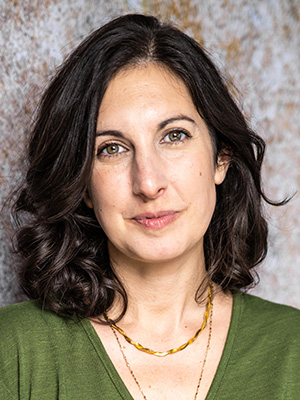
Darrah Teitel is a playwright and socialist living in Toronto where she currently works as a labour organizer. She is a graduate of The National Theatre School of Canada’s Playwriting program. Her credits include Forever Young, (Great Canadian Theatre Company); The Omnibus Bill (Counterpoint Players); Behaviour (Great Canadian Theatre Company); Corpus (Teesri Duniya), and The Apology (Alberta Theatre Projects). Darrah is the winner of several awards for her plays and has been nominated for Dora, META, Betty Mitchell and Prix Rideau awards for best new play. She was a member of the 2007, 2011, and 2012 Banff Playwrights’ Colonies, The MacDowell Colony, The Gros Morne Playwrights Residency and the Asylum Arts Peleh Family Artists Residency in Berkeley, California.
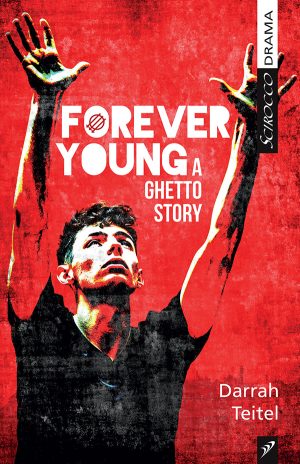
Darrah, Scirocco Drama published your play Forever Young: A Ghetto Story in 2024. Can you tell us about the play, and about how you came to write it?
Forever Young is about a group of young Jewish socialists in the Warsaw Ghetto trying to build unity across profound political differences on the eve of mass deportations to Treblinka. Although it’s set during the Holocaust, I never wanted to write a museum piece. I wanted to write about young people arguing, falling in love, making mistakes, laughing, organizing, and trying to leave something behind that might matter after they were gone.
I wrote it during the first year of the pandemic, shortly after my second child was born. Like many people, I found myself thinking about catastrophe, responsibility, and what future generations inherit from us. I kept returning to the Warsaw Ghetto fighters because they understood something I find deeply moving: even when victory seems impossible, organizing still has meaning.
Also, the Ghetto fighters were deep socialists, and I was struck by how history has erased how massive and powerful Socialist Yiddish Europe was before the Nazis murdered it.
Do you think the questions at the centre of Forever Young are particularly relevant at this moment in history?
Unfortunately, I do. The play asks what solidarity looks like under impossible conditions, how political movements navigate profound internal disagreement, and how ordinary people decide what they owe one another when institutions have completely failed them. Those questions don’t belong only to history.
One thing I’ve become increasingly interested in is the difference between politics and democracy. Politics is often about parties, governments, elections and power. Democracy, at its best, is something much more intimate. It’s the difficult practice of ordinary people making decisions together despite disagreement. I think we’re living through a period where many democratic institutions feel increasingly fragile, which makes that practice even more important.
I also hope the play resists the temptation to treat history as inevitable. My characters don’t know how their story ends. They’re making impossible choices in real time, just as we all are.
A couple of your other plays also feel very relevant to today’s political climate: The Omnibus Bill, which examines the criminalization of abortion in Canada in 1969, and Behaviour, which deals with, among other issues, the systemic inequality that affects women in the workplace. Can you tell us a little about each of the plays?
The Omnibus Bill looks at the people left behind by Canada’s celebrated 1969 reforms and asks who gets sacrificed when political compromise is presented as progress. Omnibus Bill is about sexual rights: queers, women and sex workers are the subjects. But I wanted us to pay attention in particular to how Political Liberalism exploits radical struggles such as those for Indigenous rights or feminism.
Behaviour examines gender, labour and power through women trying to survive institutions that claim to value equality while quietly reproducing hierarchy. It’s about the invisible rules that govern our workplaces and families, and the ways women are asked to perform emotional labour, absorb inequality, and police one another in order to keep those systems functioning — even up to the point of rape and assault.
Although the plays are very different, I think they ask related questions. I’m less interested in whether institutions describe themselves as progressive and calling that out, and more interested in how individuals behave in relation these obvious contradictions and compromises. Again and again, I find myself writing about people trying to build solidarity inside systems that seem determined to isolate them from one another. In those plays, the characters fail badly. Looking back, I realize that they’re the two I wrote while I was working on Parliament Hill, so that makes sense. The plays I wrote from inside labour unions have more hope.
Darrah, obviously your politics inform your writing and your life; you don’t shy away from describing yourself as a socialist in your programme bios, and your plays always invite debate and discussion about important issues. How do you balance the politics in your work with the storytelling aspects?
I’ve never really experienced politics and storytelling as separate things.
Every story contains assumptions about power, justice, love, work, family, and what makes a good society. My job isn’t to hide those questions, but it also isn’t to write speeches for ideas I (or “the left”) already agree with. It’s to create people who genuinely believe different things and allow those beliefs to collide authentically.
I think the audience has to fall in love with the characters before they’ll wrestle honestly with the ideas. If a play becomes an argument before it becomes a human story, I’ve probably failed.
More than anything, I’m interested in collective life, and I suppose at its root that is a socio-political problem. Many plays are built around individuals trying to discover themselves. Mine tend to ask how groups discover themselves. Whether it’s a resistance movement, a workplace, a family, a group of radical artists as in The Apology, or a trade union, I’m fascinated by the fragile, messy process through which people learn to act together.
How do you feel about the state of Canadian theatre these days? If you could wave a magic wand, what changes would you make?
Canadian theatre is full of extraordinary artists, but we’re asking them to make increasingly ambitious work with fewer resources, less security, and less time. Playwrights, in particular, need the freedom to develop work over years instead of months. Speaking for myself, and many other writers, we work two or three full time jobs alongside our writing. I’ve written about poverty and arts economics before, and it’s just totally miserable under capitalism—and it means we can’t do our real job, which is to challenge our communities to do better. Mostly, we just write stuff that we hope will sell, which sometimes amounts to plays that end up congratulating a theatre-subscribing audience on what they already agree with.
I’d love to see us become a little more ambitious artistically and more rigorous politically and intellectually. Theatre is one of the last places where strangers gather in a room and think together in real time. That’s an extraordinary political and artistic possibility. I’d like us to trust audiences with bigger questions, stranger forms, and more risk.
Could you give us a sneak peek of something that you’re working on right now?
I’m finishing a horror play called The Local. It’s about a gravediggers’ union in a near-future Canada preparing for a strike against “vampires” who control the blood supply.
Underneath the horror, it’s another play about organizing, democracy, love, and collective action. One of the reasons I wanted to write it is because I increasingly believe unions, in their most basic form, may become one of the last places where ordinary people still practise democracy together. Not democracy as elections or political parties, but democracy as the difficult work of making collective decisions and accepting responsibility for one another.
Across my plays I’m interested not only in democracy, but in radicalism—in people attempting to organize themselves toward more just, even utopian societies. Those efforts often fail. Sometimes they’re defeated violently. But I keep returning to them because I think they’re among the most hopeful things human beings do.
Do you have a piece of advice for aspiring playwrights?
Write toward the question you genuinely don’t know the answer to. Write to figure stuff out aloud.
Use the physical IRL space of the theatre to make people be in community together. Fuck the internet and social media altogether. I know from organizing young workers who fear coming together or talking face to face with one another: they are foul tools of nightmares and alienation. Please resist!
Finish plays. Read constantly. The obsessions you return to over and over again—the questions that won’t leave you alone—are almost always more interesting than whatever happens to be fashionable. Don’t just be an artist, or with artists. Live your life among as many kinds of people as this world can offer you. Write about them. Write for them. Writing about and for yourself will happen no matter what.