
Posted June 9, 2026
The Interview – Rose Napoli
Rose Napoli
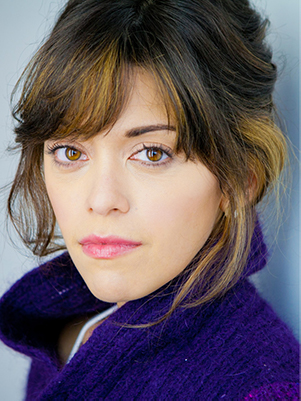
Rose Napoli is an actor and writer based in Toronto. She was named by NOW Magazine as a top ten theatre artist and has been called a “rising star” and “an artist to watch” by the Toronto Star and Globe and Mail, respectively. She has taken part in residences with the Stratford Festival, the Musical Stage Company, Nightwood and Tarragon Theatres. Rose’s plays include Mad Madge; After the Rain (co-written with Suzy Wilde); Lo (or Dear Mr. Wells) which was nominated for a Dora Award for Outstanding New Play; Legacy; A Death and the Marias; That’s Amore; Ten Creative Ways to Dispose of your Cremains, and Oregano. She is represented by Marquis Literary, is a member of the Playwrights Guild of Canada, and participated in the Canadian Film Centre’s Prime Time Television Writing Program.
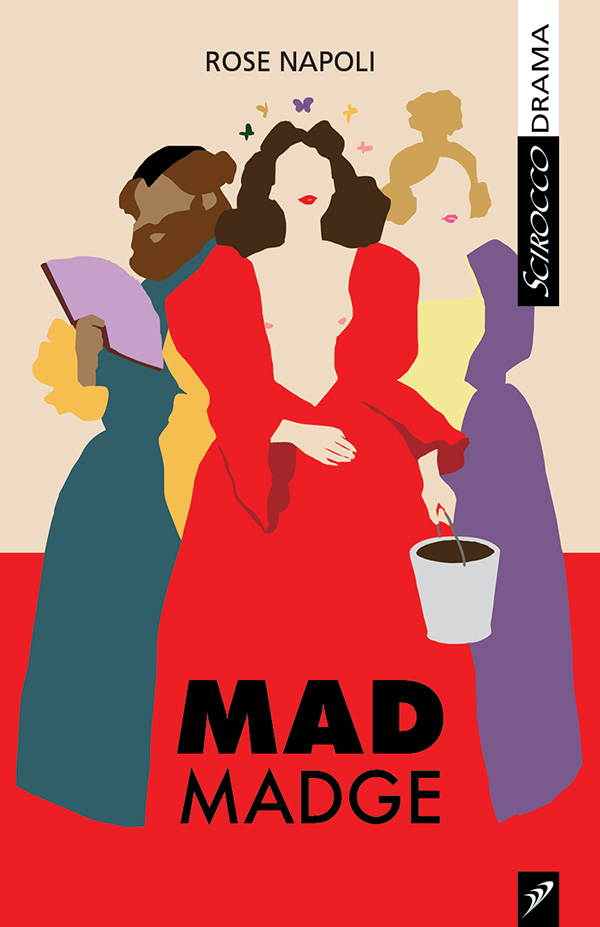
Rose, I’d like to start by asking you about two recent projects: Mad Madge and After the Rain. Let’s start with Mad Madge, which has just rolled off the presses! Tell us about how you came to write the play and about your experience performing it.
I was working on a commission for Nightwood—the initial idea was a comedy about female rage inspired by the woman who threw a chair off a condo balcony onto the Gardiner Expressway in Toronto. I was thinking a lot about the pursuit of online fame and saw the potential for something that was funny and vicious in equal measure. I happened to be simultaneously reading Danielle Dutton’s novella, Margaret the First, and was introduced to Margaret Cavendish. The more I read about her, the more it dawned on me that this hunt for attention was nothing new. I pitched Andrea a new idea: a loosely factual contemporary comedy set in the 17th century about Margaret Cavendish.
Mad Madge was recently produced at the Neptune in Halifax, with another actor in the lead role. What was it like to see an entirely different version of the play?
I loved it! Neptune played the show on their mainstage, a beautiful proscenium, with lavish production values. The premiere production in Toronto was scrappy and grounded, played in the round, which gave it an intimacy that worked well for particular moments. At Neptune, in a big theatre, the comedy was much broader, the approach much more stylized, which worked well for a whole new series of moments. It was excellent to see that the show could thrive with a different set of values. It helped me appreciate what I had created, helped me understand it more clearly. I’ve also continued to work on the script (cutting nearly ten pages after the premiere and another three after Neptune). I actually had the thought while reading the final proof of the published script: Oh! That’s how I fix that problem! For me, it’s never done. And I truly think a new work needs at least three productions before it finds itself. That’s why I’m very grateful to Jeremy at Neptune for programming it. Those subsequent productions are so vital and rare.
The other big project you’ve been involved with recently is the musical After the Rain, which you co-wrote with Suzy Wilde. Is this the first time you’ve written a musical? Can you tell us about the process and the production?
Talk about something never being finished! Making a new musical takes, on average, a decade. By that metric, Suzy and I have just passed the halfway mark with After the Rain. The first production is really a fancy workshop. I’m proud of how experimental we’ve been on that project. We’ve really challenged ourselves to play with the form of traditional music theatre. Some of our spaghetti stuck and some fell right off the wall. We’ve had an incredible team on that show, our creative partners, Marie Farsi and Rachel O’Brien. Laurence Siegel and the Tarragon who initially supported Suzy and me. Michael Rubinoff and the Musical Stage Company that are continuing to invest in developing the show long after its premiere. We had a post-premiere workshop, a second production at the National Arts Centre. And even though we evolved the show in a major way from that Tarragon production to the NAC, the team agreed on opening night in Ottawa that there is still more work to be done. It’s incredibly vulnerable to sit in process when you’ve got audiences buying tickets and reviewers writing about the show as though it were the definitive production, but Suzy is a perfect partner for me. She reminds me that we have to trust in our instincts, that we have to listen to what audiences tell us, but we also have to continue to be the protectors of our baby. I really torture myself when I’m working. Suzy is all joy. The collaborative nature of musical theatre is so thrilling. Like with television (which I also love writing for), you end up making something you simply could never have made on your own. And that’s really special.
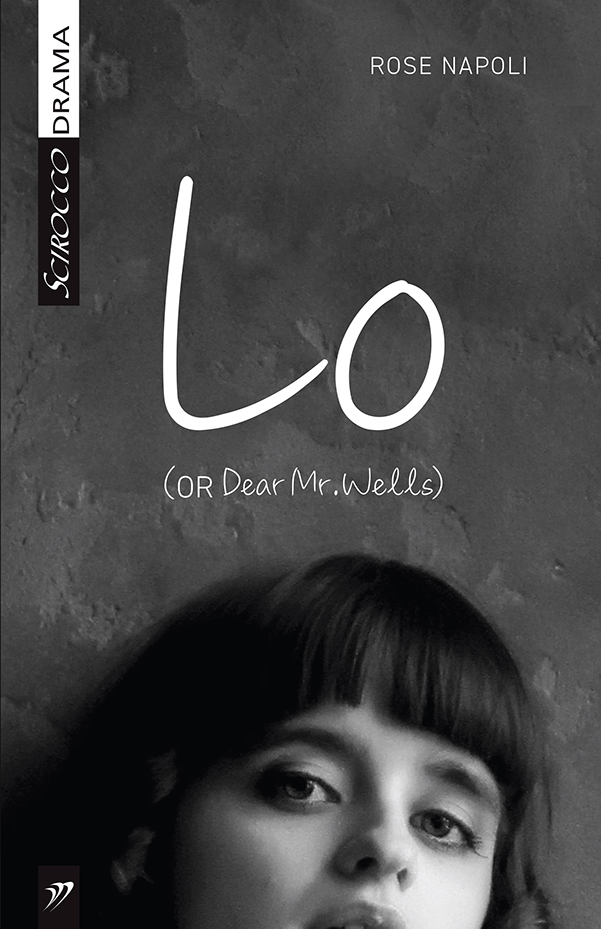
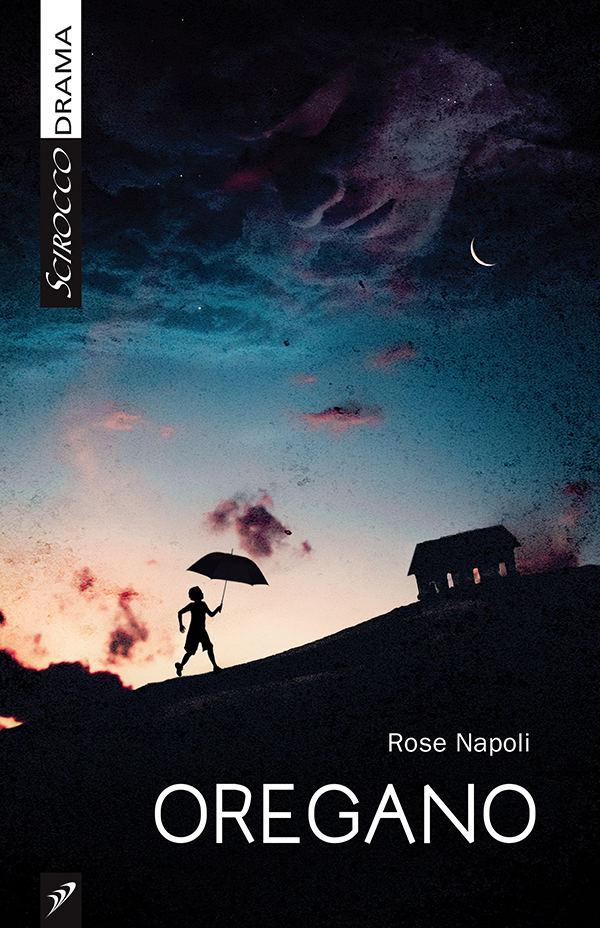
Your body of work is quite eclectic, Rose, in that a family play like Oregano has a very different feel from Lo (Or Dear Mr. Wells), which is a nuanced look at issues of consent and sexual assault, and both feel different from the madcap world of Margaret Cavendish or the musical. Do you think there are themes that run through your plays?
I am a sad clown, so my work is filled with love and levity and profound pain. And everything is autobiographical in a way. Maybe this is because I started as an actor, but I have to ferociously empathize with every character I create. It’s funny because when you say autobiography, people assume it’s the narrative that is your personal story or the lead character that is somehow based on you. But I am every character. And the better I get as a writer, the more I am able to stretch the elastic, the more I am able to start from a truth that is mine and build a character that can live outside of me. But ultimately, I’m always working inside out. I’m always asking myself a question when I start writing something and the act of building the world, populating it, and then telling a story, is my attempt to answer that question, both for myself and for an audience. But of course, there are no answers. So then, I give it up and hope that I have engaged the audience enough so that they want to work through that question with me. Then we can all sit in the discomfort of not knowing together. Everything I do is about connection.
Could you give us a sneak peek of something that you’re working on now?
I am writing an adaptation of Carlo’s Goldoni’s Mirandolina set in 1985 Woodbridge. And co-writing a comedy about a retired dairy farmer who tries online dating called The Parisian.
Do you have any advice for aspiring playwrights?
Don’t aspire, write.
-
Lo (or Dear Mr. Wells)
Price range: $9.99 through $15.95 -
Oregano
Price range: $9.99 through $15.95 -
Mad Madge
$18.95